

Medically reviewed by Dr. Kishan Srikanth Juvva, MD, DM (Pulmonary & Critical Care), Senior Consultant – Clinical & Interventional Pulmonology, Apollo Hospitals, Financial District, Hyderabad
The short answer: Asthma and COPD both narrow the airways and cause cough, wheeze and breathlessness, but they are different diseases. Asthma usually starts earlier in life, comes and goes, and the narrowing opens up with an inhaler. COPD builds up over years of breathing smoke or dust, usually shows after 40, and the narrowing stays. A spirometry test, done before and after an inhaler, is how a pulmonologist tells them apart.
Asthma and COPD are easy to confuse, even for people who have lived with one of them for years. Both cause a cough that won’t settle, wheezing, and breathlessness on the stairs. Many people carry one label for years without ever having had a breathing test to confirm it.
This matters because the two are treated differently. An inhaler that controls one can leave the other under-treated. This article explains how asthma and COPD differ, why they get mixed up, and what a lung function test actually shows.
Are asthma and COPD the same thing?
No. They share symptoms, but what is going on inside the lungs is different.
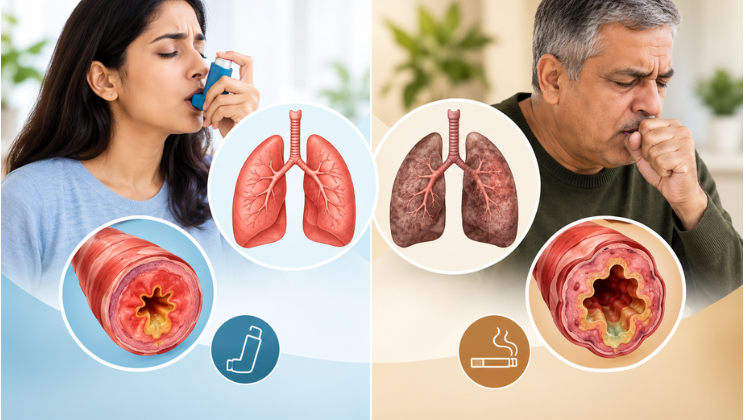
Asthma is inflammation of the airways that makes them over-sensitive. Dust, pollen, cold air, smoke, a viral cold or exercise can make the airway muscles tighten and the lining swell. Between attacks, the airways can be close to normal. Many people with asthma had it as children, or have a history of allergies, eczema or a sinus problem. Asthma can also start in adulthood, which is one reason it gets confused with COPD.
COPD (chronic obstructive pulmonary disease) is lasting damage to the airways and air sacs. It covers chronic bronchitis, where the airways stay inflamed and full of mucus, and emphysema, where the air sacs lose their elasticity. The damage comes from years of breathing in harmful particles. In most of the world that means cigarettes. In India, as we’ll see below, it very often means polluted air, cooking smoke and dust at work. COPD rarely appears before 40, and it tends to get slowly worse.
Asthma vs COPD at a glance
| Asthma | COPD | |
|---|---|---|
| Usual age when it starts | Childhood or young adulthood (can start at any age) | Usually after 40 |
| Main cause | Airway inflammation, often allergic | Years of smoke, pollution or dust exposure |
| How symptoms behave | Come and go; good days and bad days | Present most days; slowly worsen over years |
| Typical triggers | Dust, pollen, cold air, exercise, colds | Infections and pollution cause flare-ups, but breathlessness is there even without them |
| Night-time symptoms | Common (cough or wheeze waking you at 2–4 am) | Less typical; morning cough with phlegm is more common |
| Allergy or eczema history | Often present | Usually absent |
| Spirometry after a reliever inhaler | Airway narrowing improves clearly | Narrowing stays (FEV1/FVC remains below 0.70) |
| Gas transfer test (DLCO) | Usually normal | Often reduced when emphysema is present |
| FeNO breath test | Often high in allergic asthma | Usually normal |
| Main treatment | Inhaled steroid-based controller | Long-acting bronchodilator inhalers, rehabilitation; steroids added only for some patients |
| Long-term outlook | Can be well controlled; many people live without limits | Damage can’t be reversed, but progression can be slowed |
Why the symptoms get mixed up
Both conditions cause a cough, a whistling wheeze, chest tightness and breathlessness. A 60-year-old with COPD and a 60-year-old with adult-onset asthma can describe their symptoms in almost the same words. A stethoscope can’t settle it, and neither can a chest X-ray. The X-ray is often normal in asthma and in early COPD.
The pattern over time is what gives the first clue. Ask yourself these questions:
- Do your symptoms disappear for weeks, then return with a cold or a change in weather? That leans towards asthma.
- Are you breathless on the same flight of stairs every day, and has that slowly got worse over the last few years? That leans towards COPD.
- Do you bring up phlegm most mornings? That is more typical of COPD.
The pattern is only a clue, though. The diagnosis comes from measuring how air moves in and out of your lungs.
How a lung function test tells asthma and COPD apart
A pulmonary function test (PFT) is a set of breathing tests. You blow into a mouthpiece connected to a machine, following the technician’s instructions. Nothing goes into your body, there are no needles, and most people are done in 20 to 45 minutes. Here is what each part tells us.
Spirometry: is there narrowing? You breathe in fully and then blow out as hard and fast as you can. The machine records two numbers. FEV1 is how much air you push out in the first second. FVC is the total you can blow out. If FEV1 divided by FVC is below 0.70, the airways are narrowed. Both asthma and COPD can show this, so on its own it doesn’t settle the question.
Bronchodilator test: does the narrowing open up? This is the step that separates the two. You take four puffs of a reliever inhaler (salbutamol), wait about 15 minutes, and repeat spirometry. In asthma, the narrowing improves clearly. GINA, the global asthma guideline, counts a rise of more than 12% and more than 200 ml in FEV1 (or FVC) as a positive response, and the ratio often returns to normal. In COPD, the ratio stays below 0.70 even after the inhaler. That persistent narrowing (FEV1/FVC below 0.70 after the inhaler) is how the GOLD 2026 report confirms COPD.
DLCO: are the air sacs damaged? This test measures how well oxygen passes from your lungs into your blood. You take a breath of a harmless test gas and hold it for about 10 seconds. A low result points to emphysema, the air-sac damage seen in many people with COPD. In asthma, DLCO is usually normal.
FeNO: is there allergic inflammation? You breathe out slowly into a handheld device for about 10 seconds. It measures nitric oxide in your breath, a marker of allergic-type airway inflammation. In someone not yet using an inhaled steroid, a reading above 50 ppb is considered high (GINA 2025). That supports asthma and suggests an inhaled steroid will work well. It is also useful in COPD, because a raised level hints that asthma may be part of the picture.
Challenge test: when spirometry looks normal. Some people with asthma have normal results on the day of the test because their asthma is quiet. A bronchial provocation (challenge) test checks how sensitive the airways are by measuring lung function before and after a controlled trigger. It is done under the doctor’s supervision.
What the results can look like
The figures below are illustrative. They show the kind of pattern a pulmonologist looks for, not any real patient’s report.
| Person A (asthma pattern) | Person B (COPD pattern) | |
|---|---|---|
| FEV1 before inhaler | 68% of predicted | 55% of predicted |
| FEV1 after inhaler | 84% of predicted (+24%) | 58% of predicted (+5%) |
| FEV1/FVC after inhaler | 0.78 (back to normal) | 0.58 (still narrowed) |
| DLCO | Normal | Reduced |
| FeNO | 62 ppb (high) | 18 ppb (normal) |
Person A’s airways open up and the inflammation marker is high, which is a classic asthma picture. Person B’s narrowing barely moves and the gas transfer is low, which points to COPD with emphysema.
Where these tests are done
Dr. Kishan Srikanth Juvva reviews every report himself, alongside your symptoms and history. Numbers alone never make a diagnosis.
- At Apollo Hospitals, Financial District (daytime): a complete lung function lab with body box plethysmography for lung volumes, DLCO, and impulse oscillometry (IOS). IOS is a test of the small airways that works even for children and for adults who find forceful blowing difficult.
- At Breathe Well Clinic, Kondapur (evenings): spirometry with the bronchodilator test, FeNO and bronchial provocation testing, with results discussed the same evening.
Before your test: wear loose clothing and avoid a heavy meal or smoking for a few hours beforehand. Ask the clinic whether to pause your inhalers. Some need to be stopped for several hours before the bronchodilator test, but never stop a medicine without being told to.
Can asthma turn into COPD?
Not in the sense of one disease changing into the other. But two things do happen, and both are common.
First, asthma that stays poorly controlled for many years can leave lasting changes in the airway walls. Doctors call this remodelling. Over time some of the narrowing stops reversing, and the test starts to look partly like COPD. This is one of the strongest reasons to treat asthma properly from the start, rather than relying on a reliever inhaler alone.
Second, a person can have both. Someone who had asthma as a child and then smoked, or worked in dust for decades, may carry features of each. Doctors sometimes call this asthma–COPD overlap. It matters because treatment has to cover both sides: the inflammation of asthma and the fixed narrowing of COPD. The GOLD 2026 report advises that anyone with COPD who also has asthma should be on an inhaled steroid. A FeNO test and a blood eosinophil count help decide how much each side needs.
Asthma or COPD: which is worse?
Neither is “mild” if it is left untreated.
COPD is progressive. Lung tissue lost to emphysema does not grow back. The aim of treatment is to slow the decline, prevent flare-ups and keep you active. Flare-ups that need hospital admission are a real risk, especially in winter.
Asthma is usually very controllable. Most people on the right controller inhaler live without limits. But a severe asthma attack can be life-threatening, and that risk is highest in people who depend only on their reliever and skip the controller.
So the more useful question isn’t which is worse. It’s whether you know which one you have, and whether your treatment matches it.
Why this matters more in Hyderabad
In India, COPD is not only a smoker’s disease. A 2026 review in BMC Pulmonary Medicine pooled Indian studies and found COPD in about 13% of adults: 16% of men and 9% of women. Among people who cooked with biomass fuel such as wood or dung cakes, it was 8%, compared with 1% in households using LPG.
That changes who gets missed. In our OPDs, these are the people most likely to be told “it’s just asthma” or “it’s just a smoker’s cough” without a test:
- Women who cooked on firewood or coal for years in their village homes before moving to the city. Many of them have never smoked and still develop COPD.
- People living or working near construction. The building corridor around Kokapet, Narsingi and the Financial District means long-term dust exposure for workers and residents alike.
- Daily commuters on the ORR, Gachibowli and Hitech City roads, breathing traffic exhaust for hours each week.
- Adults whose childhood asthma “went away” and then returned in their 40s or 50s.
Winter makes things worse. In its most recent winter analysis (published March 2025), the Centre for Science and Environment measured Hyderabad’s average PM2.5 at 52 µg/m³ from October 2024 to January 2025. The World Health Organization’s 2021 guideline for annual PM2.5 exposure is 5 µg/m³. Add Diwali smoke in November and cold morning air, and both asthma and COPD flare-ups rise. If your cough or wheeze returns every winter, that is exactly the time to get tested, not to buy another cough syrup.
Why the right label changes your treatment
The difference isn’t academic. The two conditions are treated differently.
For asthma, an inhaled steroid-based controller is the foundation. It treats the inflammation that causes attacks. GINA 2025 lists reliever-only treatment, and over-use of reliever inhalers, as risk factors for flare-ups and uncontrolled asthma. A reliever eases symptoms but leaves the inflammation untreated.
For COPD, treatment is built on long-acting bronchodilator inhalers that keep the airways open, along with pulmonary rehabilitation, vaccination and help to stop smoking. Under GOLD 2026, inhaled steroids are added only for selected patients, based on flare-up history and blood eosinophil count. Large trials found more pneumonia in COPD patients using them, so they aren’t given to everyone.
That is why a diagnosis made only on symptoms, or only from an X-ray, can leave a patient on the wrong inhaler for years.
When to see a pulmonologist
Book a lung function test with a pulmonologist if any of these sound familiar:
- You use a reliever inhaler more than twice a week, or it seems to help less than it used to.
- Cough or wheeze wakes you at night.
- You get breathless on stairs or a short walk that used to be easy.
- A cough has lasted longer than three weeks, or you get “bronchitis” every winter.
- You are over 40 and have smoked, cooked on firewood, or worked around dust, fumes or chemicals.
- You were told you have asthma or COPD years ago, but never had spirometry.
Go to an emergency department straight away if you can’t speak in full sentences, your lips or fingertips turn bluish, or your reliever inhaler isn’t helping during an attack.
Getting a clear diagnosis in Hyderabad
Dr. Kishan Srikanth Juvva is a pulmonologist in Hyderabad and Senior Consultant in Clinical & Interventional Pulmonology and Sleep Medicine at Apollo Hospitals, Financial District. He has more than 12 years of experience. His training covers every step from the breathing test to the bronchoscope:
- MD from Guntur Medical College
- DM in Pulmonary & Critical Care Medicine from VMMC & Safdarjung Hospital, New Delhi, after securing All India Rank 2 in NEET Super Speciality
- Master’s in Interventional Pulmonology from the University of Florence, Italy
- Fellowship in Sleep Medicine from ISDA, New Delhi
He sees patients with asthma, COPD and overlap at two locations in west Hyderabad.
| Apollo Hospitals, Financial District | Breathe Well Clinic, Kondapur | |
|---|---|---|
| Timings | Monday–Saturday, 9:00 AM–5:00 PM | Monday–Saturday, 5:00–8:30 PM |
| Lung tests on site | Complete PFT lab: spirometry, body box, DLCO, IOS | Spirometry with bronchodilator test, FeNO, challenge test |
| Address | 1st Floor, Room 3, Apollo Hospitals, Financial District, Nanakramguda | 1st Floor, Kadiri’s Apurupa Urban Apartments, Botanical Garden Road, beside Aparna Heights 1, Kondapur |
| Convenient from | Gachibowli, Kokapet, Narsingi, Manikonda, Puppalaguda | Kothaguda, Madhapur, Hitech City, Hafeezpet, Miyapur |
| Book | +91 90598 73547 | +91 87122 23696 |
If you work office hours, the Kondapur evening OPD lets you get tested without taking a day off. If your doctor suspects something more than asthma or COPD, such as a lung nodule or interstitial lung disease, advanced tests and procedures are available at Apollo, Financial District.
Bring with you: all your current inhalers and medicines, any old spirometry or chest X-ray/CT reports, and a note of when your symptoms are worst.
Frequently asked questions
1. Can a chest X-ray tell asthma and COPD apart?
No. A chest X-ray is often normal in asthma and in early COPD. It is useful for ruling out other problems such as infection, but the diagnosis of asthma or COPD needs spirometry.
2. Can I have both asthma and COPD?
Yes. People with long-standing asthma who also smoked, or were exposed to dust or smoke for years, can have features of both. Testing shows how much of each is present, which shapes the treatment.
3. Can a non-smoker get COPD?
Yes, and in India it is common. Long-term exposure to cooking smoke from wood or coal, outdoor air pollution and workplace dust can all cause COPD in people who have never smoked.
4. Is COPD curable?
The lung damage in COPD can’t be reversed. With the right inhalers, pulmonary rehabilitation, vaccination and avoiding smoke and dust, most people can slow its progress, have fewer flare-ups and stay active.
5. Will my asthma go away?
Asthma is controlled rather than cured. Some children outgrow symptoms, but they can return in adulthood. With the right controller inhaler, most adults with asthma have few or no symptoms.
6. How long does a lung function test take, and does it hurt?
Spirometry with a bronchodilator test takes about 20–30 minutes. A full PFT with DLCO and lung volumes takes up to 45 minutes. It doesn’t hurt. You may feel a little tired or light-headed from the repeated deep breaths, and that passes quickly.
Medically reviewed by Dr. Kishan Srikanth Juvva, MD, DM (Pulmonary & Critical Care), Senior Consultant, Apollo Hospitals, Financial District, Hyderabad. This article is for general information and does not replace a consultation with your doctor.
Sources
- Global Initiative for Chronic Obstructive Lung Disease. GOLD 2026 Report, version 1.3, December 2025 (diagnosis of COPD by spirometry)
- Indian Health Service. COPD guidelines formulary brief, August 2026 (GOLD 2026 on inhaled steroids, eosinophils, pneumonia and coexisting asthma)
- The Lancet Respiratory Medicine. Summary of the 2025 GINA report for asthma, August 2025 (FeNO thresholds, reliever-only treatment risk)
- ATS 2025 International Conference. GINA vs ATS/ERS bronchodilator responsiveness thresholds, May 2025 (Am J Respir Crit Care Med 2025;211:A3072)
- Burden of chronic obstructive pulmonary disease among Indian adults: systematic review and meta-analysis, BMC Pulmonary Medicine 26:112, February 2026
- Centre for Science and Environment. Winter pollution crisis in megacities of India: Hyderabad, March 2025
- World Health Organization. WHO global air quality guidelines, September 2021; annual PM2.5 value as summarised by IQAir