

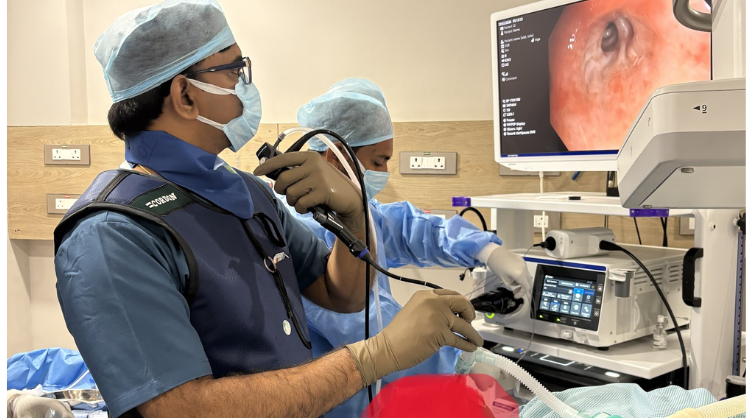
Medically reviewed by Dr. Kishan Srikanth Juvva, MD, DM (Pulmonary & Critical Care), Master’s in Interventional Pulmonology (University of Florence), Senior Consultant – Clinical & Interventional Pulmonology, Apollo Hospitals, Financial District, Hyderabad
The short answer: Bronchoscopy is usually not painful. Your throat and nose are numbed with a local anaesthetic spray, and you are given a sedative so you feel relaxed and drowsy. Most people feel some pressure and may cough, but not pain. The procedure itself takes about 20 minutes. You rest for 1–2 hours afterwards and usually go home the same day.
Hearing that you need a camera passed into your lungs is unsettling, and most of the worry comes from not knowing what to expect. This article walks through what a bronchoscopy is, what you’ll feel, what happens on the day, the side effects and risks, and when your results come back.
What is a bronchoscopy?
A bronchoscopy is a test in which a doctor looks inside your airways with a bronchoscope: a thin, flexible tube, about as wide as a pencil, with a camera and light at its tip. It passes through the nose or mouth, down past the vocal cords and into the windpipe and the airways of each lung.
As well as looking, the doctor can take samples through the scope:
- Bronchoalveolar lavage (BAL): a small amount of sterile saline is washed into part of the lung and suctioned back, then tested for infection, including TB, and for abnormal cells.
- Brushings and biopsies: tiny tissue samples from the airway wall or the lung.
- Needle samples from lymph nodes: taken with ultrasound guidance during an EBUS procedure.
Why would a doctor order a bronchoscopy?
Common reasons include:
- A shadow, nodule or mass on a chest X-ray or CT that needs a diagnosis
- A suspected infection that sputum tests haven’t confirmed, including TB
- Coughing up blood
- A cough or lung problem that hasn’t responded to treatment
- Interstitial lung disease, where a sample helps identify the type
- Treatment: clearing a thick mucus plug or removing something accidentally inhaled
In India, bronchoscopy is especially useful when TB and lung cancer are both possible. One set of samples can be tested for both.
Will I be awake or asleep?
For most bronchoscopies you are given sedation, not a full general anaesthetic. A sedative is injected into a vein in your hand or arm. You stay breathing on your own, but you feel calm and drowsy, and many people remember little or nothing of the procedure afterwards.
Some procedures are done under deeper sedation or general anaesthesia, depending on what is planned and on your health. These include longer EBUS procedures and rigid bronchoscopy. Your doctor will tell you in advance which you’ll have.
Does bronchoscopy hurt?
For most people, no. Before the scope goes in, your nose and throat are numbed with a local anaesthetic spray. More anaesthetic is sprayed onto the vocal cords and airways through the scope as it moves down. This stops the coughing reflex and the discomfort.
What people usually describe is:
- A bitter taste from the spray, and a feeling that your throat is “thick”
- Some pressure as the scope passes through the nose
- An urge to cough, especially in the first few minutes
- A brief cool feeling if a lavage is done
A biopsy taken from inside the lung isn’t felt as pain, because the lung tissue has no pain-sensing nerves of that kind. If you feel uncomfortable at any point, the team can give more sedation or local anaesthetic.
Nose or mouth?
The scope usually goes in through the nose. If the nasal passage is narrow, or for some procedures such as EBUS, it goes through the mouth with a small mouthguard to protect the scope and your teeth.
How long does a bronchoscopy take?
- The procedure itself: about 20 minutes for a standard bronchoscopy. An EBUS or a bronchoscopy with several biopsies takes longer.
- Recovery: about 1–2 hours resting while the sedative wears off and your breathing and oxygen are monitored.
- Overall: plan for about half a day at the hospital, including check-in and paperwork.
Is it a major or minor procedure?
A standard diagnostic bronchoscopy is a minor, day-care procedure. There are no cuts or stitches, and most people go home the same day. It is still an invasive test done under sedation, which is why it needs fasting beforehand, monitoring afterwards and someone to take you home.
What happens on the day: step by step
| When | What happens | What you need to do |
|---|---|---|
| A few days before | Consultation, consent, and any blood tests or scans your doctor needs | Tell the doctor about blood thinners (aspirin, clopidogrel, warfarin or newer anticoagulants), diabetes medicines, allergies and heart or breathing problems. Don’t stop any medicine on your own. |
| 6 hours before | Fasting starts | No food. Sips of water are usually allowed until 2 hours before, unless the hospital tells you otherwise. |
| Arrival | Check-in, a small cannula in your hand or arm, monitors attached | Bring your CT scan films or CD, earlier reports and a list of medicines. Come with an adult who can take you home. |
| Just before | Local anaesthetic spray to the nose and throat; sedative through the cannula | Tell the team if you feel anxious; they can adjust the sedation. |
| About 20 minutes | The bronchoscopy: the scope is passed, the airways examined and samples taken | Breathe normally. Oxygen is given through a small tube in your nose, and your oxygen level and heart rate are watched throughout. |
| 1–2 hours after | Recovery while the sedative wears off | Don’t eat or drink until the numbness in your throat has worn off. The nurse will check your swallowing first. |
| Rest of the day | Home, with an adult staying overnight | No driving or operating machinery for 24 hours. |
Fasting, recovery and driving advice follow the University Hospitals Sussex NHS Foundation Trust bronchoscopy patient leaflet (December 2025). Your hospital’s instructions take priority.
Side effects and recovery
Most side effects are mild and settle within a day or two:
- A sore throat or nose
- A hoarse voice
- Coughing, sometimes with small streaks of blood, especially after a biopsy
- Drowsiness for the rest of the day from the sedative
- A mild temperature or feeling achy the same evening, particularly after a lavage
Most people are back to normal activities the next day. Warm fluids and rest help the throat. Avoid smoking, and if you had a biopsy, avoid heavy exertion for a day.
How safe is bronchoscopy?
Bronchoscopy is a routine procedure, and serious complications are uncommon. The NHS patient information describes significant bleeding and a collapsed lung (pneumothorax) as rare. The risk depends mainly on what is done: simply looking carries the least risk, while biopsies from deep in the lung carry a little more.
For context, a prospective study published in Cancers in 2023 followed 697 patients for 30 days after EBUS or guided bronchoscopy, the more advanced procedures used to diagnose lung nodules and cancer. Severe complications occurred in 2.4% of them.
Your own risk depends on your lung function, heart health, blood thinners and the type of sampling planned. Your doctor will go through this with you before you sign the consent form.
Contact the hospital or go to emergency straight away if you have:
- New or worsening breathlessness or chest pain
- Coughing up more than a few streaks of blood
- A high fever that lasts beyond the next day
- Difficulty swallowing once the numbness should have worn off
When will I get my bronchoscopy results?
Different samples take different amounts of time:
- What the doctor saw during the procedure can usually be explained once you’re awake.
- Rapid TB tests on the lavage fluid are usually available within days.
- Biopsy and cytology reports from the pathology lab usually take several working days.
- TB and fungal cultures take several weeks to grow, so a final answer on infection can take longer.
Your doctor will usually review all the reports together at a follow-up visit and explain the next step.
Bronchoscopy in Hyderabad with Dr. Kishan Srikanth Juvva
Dr. Kishan Srikanth Juvva is an interventional pulmonologist in Hyderabad and Senior Consultant in Clinical & Interventional Pulmonology at Apollo Hospitals, Financial District. He performs bronchoscopy in Hyderabad and related procedures at Apollo’s bronchoscopy suite.
His training:
- MD from Guntur Medical College
- DM in Pulmonary & Critical Care Medicine from VMMC & Safdarjung Hospital, New Delhi (All India Rank 2, NEET Super Speciality)
- Master’s in Interventional Pulmonology from the University of Florence, Italy, with training in flexible bronchoscopy, EBUS (linear and radial), medical thoracoscopy and foreign body removal
- Fellowship in Sleep Medicine from ISDA, New Delhi
The consultation before your procedure, and the follow-up to discuss results, can be at either location.
| Apollo Hospitals, Financial District | Breathe Well Clinic, Kondapur | |
|---|---|---|
| Best for | Bronchoscopy, EBUS and other procedures; daytime consultation | Evening consultation before the procedure and results follow-up |
| Timings | Monday–Saturday, 9:00 AM–5:00 PM | Monday–Saturday, 5:00–8:30 PM |
| Address | 1st Floor, Room 3, Apollo Hospitals, Financial District, Nanakramguda | 1st Floor, Kadiri’s Apurupa Urban Apartments, Botanical Garden Road, beside Aparna Heights 1, Kondapur |
| Convenient from | Gachibowli, Kokapet, Narsingi, Manikonda, Jubilee Hills | Kothaguda, Madhapur, Hitech City, Hafeezpet, Miyapur |
| Book | +91 90598 73547 | +91 87122 23696 |
Frequently asked questions
1. How long does a bronchoscopy take?
The procedure itself takes about 20 minutes, followed by 1–2 hours of recovery. EBUS or multiple biopsies take longer.
2. Can I go home the same day?
Yes, most people do. You’ll need an adult to take you home and stay with you overnight, and you shouldn’t drive for 24 hours.
3. How many hours should I fast before a bronchoscopy?
Usually no food for 6 hours beforehand, with sips of water allowed up to 2 hours before. Always follow the exact instructions your hospital gives you.
4. Are bronchoscopy and endoscopy the same?
Both use a flexible camera, but they look at different organs. A bronchoscopy goes into the windpipe and lungs. An endoscopy of the stomach goes down the food pipe.
5. Can bronchoscopy detect lung cancer or TB?
Yes. Samples taken during a bronchoscopy can be tested for both cancer cells and TB, which is why it is often the next step when a scan shows a shadow or nodule.
6. Can a bronchoscopy remove mucus or something I inhaled?
Yes. Therapeutic bronchoscopy can clear thick mucus plugs and remove inhaled foreign bodies. Your doctor will tell you whether it’s suitable in your case.
Medically reviewed by Dr. Kishan Srikanth Juvva, MD, DM (Pulmonary & Critical Care), Master’s in Interventional Pulmonology, Senior Consultant, Apollo Hospitals, Financial District, Hyderabad. This article is for general information and does not replace a consultation with your doctor.
Sources
- University Hospitals Sussex NHS Foundation Trust. Bronchoscopy: patient information, published December 2025 (fasting, sedation, duration, recovery, driving, side effects)
- Thirty-Day Complications, Unplanned Hospital Encounters, and Mortality after Endosonography and/or Guided Bronchoscopy: A Prospective Study, Cancers, September 2023