

Medically reviewed by Dr. Kishan Srikanth Juvva, MD, DM (Pulmonary & Critical Care), Fellowship in Sleep Medicine (ISDA), Senior Consultant – Clinical & Interventional Pulmonology and Sleep Medicine, Apollo Hospitals, Financial District, Hyderabad
The short answer: Yes, untreated sleep apnea can be dangerous, though not usually overnight. The real harm builds over years. Repeated drops in oxygen during sleep strain the heart and blood vessels, raise blood pressure, and are linked to atrial fibrillation, stroke, diabetes and memory problems. The daytime sleepiness it causes also raises the risk of accidents. The good news is that it can be diagnosed with a sleep study and treated.
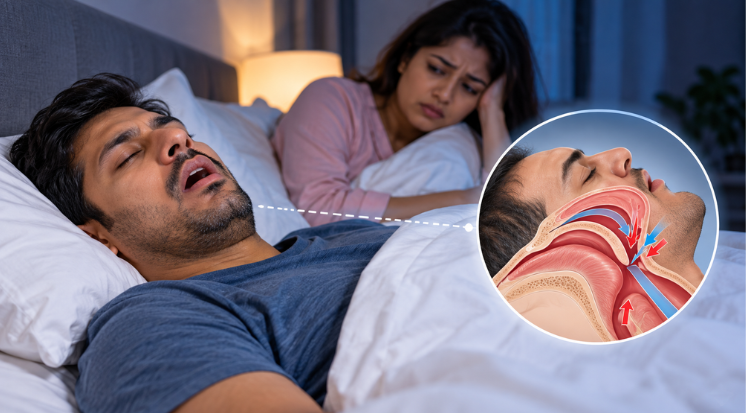
Many people with sleep apnea don’t know they have it. The person who notices first is usually the one sleeping beside them: loud snoring, then silence, then a gasp. This article explains what sleep apnea does to the body, when it is considered severe, and whether treatment actually lowers the risk.
What is obstructive sleep apnea?
In obstructive sleep apnea (OSA), the throat relaxes and narrows during sleep until the airway partly or fully closes. Breathing stops (an apnea) or becomes very shallow (a hypopnea) for 10 seconds or more. Oxygen levels fall, the brain jolts you into lighter sleep to reopen the airway, and the cycle repeats. In severe cases it happens more than 30 times an hour, all night, usually without the person remembering any of it.
How common is sleep apnea in India?
More common than most people assume. A 2023 systematic review by AIIMS New Delhi, published in Sleep Medicine Reviews, found that about 11% of Indian adults have OSA: 13% of men and 5% of women. That works out to roughly 10.4 crore working-age Indians, of whom about 4.7 crore have moderate to severe disease.
What sleep apnea does to your body
Every pause in breathing sets off the same chain. Oxygen drops, the body releases stress hormones, heart rate and blood pressure surge, and sleep is broken. One night of this is harmless. Years of it, hundreds of times a night, is what causes the damage.
Blood pressure
This is the most consistent link. The nightly surges in blood pressure gradually carry over into the daytime. In its 2021 scientific statement, the American Heart Association recommends screening for sleep apnea in anyone whose high blood pressure is resistant or poorly controlled despite medicines. If you take three or more BP tablets and your readings are still high, sleep apnea is worth ruling out.
Heart rhythm, heart failure and stroke
The same AHA statement reports that sleep apnea is found in 40–80% of people with high blood pressure, heart failure, coronary artery disease, pulmonary hypertension, atrial fibrillation and stroke. Atrial fibrillation, an irregular heartbeat, matters most here because it raises the risk of stroke. The AHA advises a formal sleep assessment for people with heart failure who have symptoms suggesting sleep-disordered breathing.
Diabetes
Low oxygen and broken sleep make the body less responsive to insulin. A 2025 meta-analysis in the Journal of Diabetes Investigation found diabetes was about twice as common in people with OSA as in those without it (odds ratio 2.29). The link was stronger in people under 50 (odds ratio 3.28). If you have diabetes that is hard to control and you snore, mention it to your doctor.
Memory, concentration and dementia
Morning headaches, poor concentration and forgetfulness are common complaints. Over the longer term, a 2024 meta-analysis of cohort studies in Sleep & Breathing found people with sleep apnea had about a 52% higher risk of cognitive impairment or dementia (hazard ratio 1.52). The authors note the link was weaker in studies that confirmed sleep apnea with a full sleep study, so this is an association, not proof of cause.
Daytime sleepiness and driving
People with untreated sleep apnea often feel tired however long they sleep. They nod off in meetings, in front of the TV or, most dangerously, at the wheel. If you have ever caught yourself drowsy while driving on the ORR or during a long commute, treat it as a warning sign, not a lifestyle problem.
Mood and relationships
Irritability, low mood and a partner who has moved to another room because of the snoring are common reasons people finally come in. They are worth taking seriously too.
When is sleep apnea considered severe?
Severity is measured with the apnea–hypopnea index (AHI): the average number of breathing pauses and shallow-breathing episodes per hour of sleep. It comes from a sleep study.
| AHI (events per hour) | Severity |
|---|---|
| Fewer than 5 | Within normal range for adults |
| 5 to 15 | Mild |
| 15 to 30 | Moderate |
| More than 30 | Severe |
Categories as defined by the American Academy of Sleep Medicine.
The AHI isn’t the whole picture. How low your oxygen drops, how sleepy you are in the day, and whether you already have high blood pressure, heart disease or diabetes all shape how urgent treatment is. A person with “moderate” sleep apnea and heart disease may need treatment more urgently than a healthy person with a higher number.
Warning signs to watch for
At night (usually noticed by a partner):
- Loud, regular snoring
- Pauses in breathing, followed by choking or gasping
- Restless sleep, or getting up often to pass urine
During the day:
- Waking up unrefreshed, often with a headache or dry mouth
- Falling asleep easily while reading, watching TV or in traffic
- Poor concentration, irritability or low mood
Who is more likely to have sleep apnea?
- Men (the AIIMS review found it in 13% of Indian men, against 5% of women)
- People who are overweight, especially with a thick neck
- Adults over 40, and women after menopause
- People with high blood pressure, diabetes, heart disease or atrial fibrillation
- Those who drink alcohol in the evening or take sleeping pills, which relax the throat further
- People with a blocked nose, large tonsils or a small or set-back jaw
- Anyone with a family history of sleep apnea
You don’t have to be overweight to have it. Jaw and airway shape matter too, which is why slim people can have significant sleep apnea.
Does treatment lower the risk?
Treatment clearly helps how you feel: better sleep, less daytime sleepiness and sharper concentration. For the heart and blood pressure, the picture is more specific.
- CPAP (a small bedside machine that keeps the airway open with gentle air pressure) is the standard treatment for moderate to severe OSA (more on CPAP and BiPAP therapy). A 2025 worldwide meta-analysis of individual patient data in the European Respiratory Journal found CPAP lowered blood pressure mainly in people whose blood pressure was not controlled. In that group, systolic pressure fell by about 2.6 mmHg on average, against no change in those already controlled. The benefit depends on using the machine every night.
- Weight loss reduces the severity of sleep apnea in people who are overweight, and helps blood pressure and blood sugar at the same time.
- Positional therapy helps people whose apnea happens mainly when lying on their back.
- Oral appliances made by a dentist can help some people with mild to moderate OSA who can’t tolerate CPAP.
- Treating a blocked nose, enlarged tonsils or jaw problems can help selected patients, sometimes with an ENT surgeon’s input.
- Avoiding alcohol and sleeping pills in the evening reduces how much the throat collapses.
Whether treatment prevents heart attacks and strokes in the long run is still being studied. What isn’t in doubt is that untreated moderate to severe sleep apnea, alongside high blood pressure, diabetes or heart disease, should not be left alone.
How sleep apnea is diagnosed
The diagnosis needs a sleep study, which records your breathing, oxygen level, heart rate and sleep through the night.
- In-lab polysomnography at Apollo Hospitals, Financial District is the most complete test. It also lets the CPAP pressure be set during the same study when needed.
- A home sleep test may suit people with a high likelihood of moderate to severe OSA and no major heart or lung disease. Your doctor will advise which test is right for you.
Our upcoming article on sleep study cost and home vs in-lab testing goes into more detail.
Seeing a sleep specialist in Hyderabad
Dr. Kishan Srikanth Juvva is a pulmonologist in Hyderabad with a Fellowship in Sleep Medicine from ISDA, New Delhi. He is Senior Consultant in Clinical & Interventional Pulmonology and Sleep Medicine at Apollo Hospitals, Financial District. Because sleep apnea so often comes with high blood pressure, diabetes, asthma or COPD, he assesses the lungs and airway as a whole, not just the snoring. His other qualifications:
- MD from Guntur Medical College
- DM in Pulmonary & Critical Care Medicine from VMMC & Safdarjung Hospital, New Delhi (All India Rank 2, NEET Super Speciality)
- Master’s in Interventional Pulmonology from the University of Florence, Italy
| Apollo Hospitals, Financial District | Breathe Well Clinic, Kondapur | |
|---|---|---|
| Best for | Consultation and in-lab sleep study (polysomnography) | Evening consultation, CPAP/BiPAP setup and follow-up |
| Timings | Monday–Saturday, 9:00 AM–5:00 PM | Monday–Saturday, 5:00–8:30 PM |
| Address | 1st Floor, Room 3, Apollo Hospitals, Financial District, Nanakramguda | 1st Floor, Kadiri’s Apurupa Urban Apartments, Botanical Garden Road, beside Aparna Heights 1, Kondapur |
| Convenient from | Gachibowli, Kokapet, Narsingi, Manikonda, Jubilee Hills | Kothaguda, Madhapur, Hitech City, Hafeezpet, Miyapur |
| Book | +91 90598 73547 | +91 87122 23696 |
If you work in Gachibowli or Hitech City, the Kondapur evening OPD lets you come in after office hours.
Bring with you: your bed partner if possible (they often describe the snoring and pauses best), a list of your medicines, your latest BP and blood sugar readings, and any earlier sleep study report.
Frequently asked questions
1. Can sleep apnea kill you in your sleep?
Sleep apnea rarely causes sudden death on its own on a given night, because the brain wakes you to restart breathing. The danger is long-term: untreated sleep apnea is linked to high blood pressure, atrial fibrillation, heart failure and stroke, and the sleepiness it causes raises the risk of accidents.
2. Can sleep apnea cause a heart attack or stroke?
It is strongly linked to both. The American Heart Association reports sleep apnea in 40–80% of people with conditions such as coronary artery disease, atrial fibrillation and stroke. It raises blood pressure and strains the heart, which adds to that risk.
3. Will sleep apnea go away on its own?
Usually not. It can improve with weight loss, cutting out evening alcohol or treating a blocked nose, but moderate to severe sleep apnea generally needs treatment such as CPAP.
4. Which doctor treats sleep apnea?
A pulmonologist or sleep medicine specialist diagnoses it with a sleep study and manages treatment. An ENT surgeon or dentist may be involved for some patients.
5. Can a thin person have sleep apnea?
Yes. Excess weight is a major risk factor, but jaw shape, a narrow airway, large tonsils and nasal blockage can cause sleep apnea in slim people too.
6. Do I have to use CPAP for life?
CPAP keeps the airway open while you use it, so the benefit lasts only as long as you keep using it. Some people can reduce or stop after significant weight loss or other treatment, but only after a repeat sleep study confirms it.
Medically reviewed by Dr. Kishan Srikanth Juvva, MD, DM (Pulmonary & Critical Care), Fellowship in Sleep Medicine, Senior Consultant, Apollo Hospitals, Financial District, Hyderabad. This article is for general information and does not replace a consultation with your doctor.
Sources
- Suri TM, Mohan A, et al. (AIIMS New Delhi). Systematic review and meta-analysis of the prevalence of obstructive sleep apnea in Indian adults, Sleep Medicine Reviews, 2023, as reported by IANS / National Herald, October 2023
- Yeghiazarians Y, et al. Obstructive Sleep Apnea and Cardiovascular Disease: A Scientific Statement from the American Heart Association, Circulation, 2021, summarised by the American College of Cardiology
- Association between obstructive sleep apnea syndrome and type 1/type 2 diabetes mellitus: a systematic review and meta-analysis, Journal of Diabetes Investigation, 2025
- Association between sleep apnoea and risk of cognitive impairment and Alzheimer’s disease: a meta-analysis of cohort-based studies, Sleep & Breathing, 2024
- Effect of CPAP therapy on blood pressure in patients with obstructive sleep apnoea: a worldwide individual patient data meta-analysis, European Respiratory Journal, January 2025
- American Academy of Sleep Medicine AHI severity categories, as summarised by Radiopaedia