

Medically reviewed by Dr. Kishan Srikanth Juvva, MD, DM (Pulmonary & Critical Care), Senior Consultant – Clinical & Interventional Pulmonology and Sleep Medicine, Apollo Hospitals, Financial District, Hyderabad
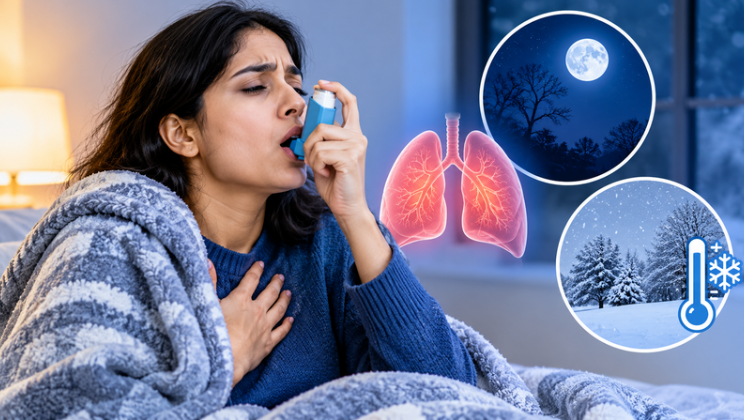
The short answer: Asthma gets worse at night because the body’s internal clock narrows the airways and increases airway inflammation in the early hours, usually around 4 AM. Lying down, bedroom dust mites and acid reflux add to it. Winter adds cold, dry air, more colds and flu, and more trapped pollution. Waking at night with cough or wheeze isn’t “normal for asthma”. It’s a sign your asthma isn’t well controlled, and that’s usually fixable with the right daily treatment
If you have asthma, you’ve probably noticed the pattern: fine during the day, then coughing or wheezing at 3 or 4 in the morning. In Hyderabad it often gets worse from November to February. This article explains why it happens, what it means, and what to do about it.
Why is asthma worse at night?
Several things happen together while you sleep.
Your body clock narrows the airways
Everyone’s airways narrow slightly at night, but in asthma the change is much bigger. Research on the body’s circadian clock shows that airway inflammation and airway narrowing peak in the early hours, around 4 AM. Lung function is at its lowest then (Thorax, 2021). Levels of the body’s natural steroid hormone, cortisol, are also at their lowest overnight, which leaves airway inflammation less held in check.
This is why night symptoms are so common. A widely cited study found that 74% of people with asthma woke at night with symptoms at least once a week. That figure comes from the late 1980s, when fewer patients used preventer inhalers, so it is likely an overestimate today. But it shows how central night symptoms are to asthma. The same review notes that most fatal asthma attacks in hospital happen overnight or in the early morning.
Lying down
Lying flat can make it harder to clear mucus. It can also let stomach acid move up into the food pipe (reflux), which irritates the airways. Mucus from the nose can drip down the back of the throat (post-nasal drip) and set off coughing.
Bedroom triggers
You spend hours breathing close to your pillow and mattress. Common bedroom triggers include:
- house dust mites in pillows, mattresses, blankets and soft toys
- pets sleeping on or near the bed
- dust on ceiling fans and air-conditioner filters, blown around all night
- mosquito coils and incense burned in a closed room
- cold air from an air-conditioner set very low
The inhaler wears off
If you take a preventer inhaler only in the morning, or forget doses, there may be little protection left by the early hours.
Why is asthma worse in winter?
Cold, dry air
Breathing cold, dry air cools and dries the lining of the airways, which can make them tighten. Early-morning walks, two-wheeler rides and the first breath outdoors on a chilly morning are classic triggers. Hyderabad mornings in winter can fall to around 12–15°C, and lower on the outskirts (Telangana Today, Nov 2024).
Colds and flu
Viral infections are the most common trigger of asthma attacks, and they circulate more in the cooler months. A cold that would be a mild nuisance for others can set off weeks of cough and wheeze in someone with asthma. A yearly flu vaccine is recommended for people with asthma.
Trapped pollution
On still, cool winter days, pollution stays close to the ground. In Hyderabad, the average PM2.5 over winter 2024–25 was 52 µg/m³, more than three times the WHO’s 24-hour guideline of 15 µg/m³ (Centre for Science and Environment, 2025). In early December 2025, the air-quality index at the Hyderabad Central University station in Gachibowli doubled in four days to 209, into the “poor” range. Other stations, including Sanathnagar and Patancheru, also crossed 200 (Patrika, 2 Dec 2025). Bonfires around Bhogi in January, and waste burning, add smoke at the same time of year.
Indoor allergens
Closed windows mean more time indoors with dust mites and mould. Hyderabad doctors have reported allergy cases rising by around 40% in winter, mostly from house dust mites and moulds (Telangana Today, Dec 2022).
Is a cough at night always asthma?
No. A cough at night is one of the most common signs of asthma, especially in children and in “cough-variant” asthma, where cough is the main symptom. But it can also come from:
- post-nasal drip from a blocked or allergic nose
- acid reflux, especially after a late, heavy dinner
- a lingering cough after a cold or flu, which can last three to eight weeks
- certain blood pressure medicines (ACE inhibitors)
- heart failure, where breathlessness when lying flat is the clue
- sleep apnea, which is also linked to night-time reflux and cough
A night cough that keeps coming back, or lasts more than three weeks, is worth checking. A breathing test usually shows whether asthma is behind it.
When is asthma “out of control”?
International asthma guidance (GINA) uses four simple questions about the last four weeks:
- Have you had asthma symptoms in the daytime more than twice a week?
- Has asthma woken you at night, even once?
- Have you needed your reliever inhaler more than twice a week?
- Has asthma limited what you could do?
If you answer “yes” to any of these, your asthma isn’t fully controlled. Waking at night is one of the clearest signs, and it’s a reason to review your treatment, not something to put up with.
How to sleep better with asthma
Get the daily treatment right
This makes the biggest difference. Current guidance (GINA) is that adults and teenagers with asthma shouldn’t rely on a reliever inhaler alone. Their treatment should include an inhaled corticosteroid (a preventer), taken as prescribed. If you’re waking at night, your doctor may:
- check your inhaler technique, as many people don’t get the medicine into their lungs
- adjust the dose or the type of inhaler
- check that you’re taking it at the right time of day
- look for other problems, such as nasal allergy, reflux or sleep apnea
Never stop or change asthma medicines on your own.
Make the bedroom asthma-friendly
- Wash pillow covers, bedsheets and blankets weekly in hot water, and dry them in the sun.
- Use dust-mite-proof covers for pillows and mattresses if dust mites are a trigger.
- Keep pets out of the bedroom.
- Clean the ceiling fan and the AC filter regularly.
- Don’t burn mosquito coils or incense in the bedroom. Use bed nets or window screens instead.
- Don’t set the AC very cold. A moderate temperature is gentler on the airways.
Before bed
- Have dinner at least two to three hours before lying down if reflux is a problem.
- If your nose is blocked at night, treat the nasal allergy too. A blocked nose often makes night cough worse.
In winter
- Cover your nose and mouth with a scarf or mask on cold mornings, especially on a two-wheeler.
- Check the air-quality index before outdoor exercise on hazy days. Exercise indoors or later in the day if it’s poor.
- Get the flu vaccine every year.
- Keep your reliever inhaler with you, and keep a spare at home.
What to do if asthma wakes you up
- Sit upright rather than lying flat.
- Take your reliever inhaler, ideally with a spacer, as your doctor has advised, or follow your written asthma action plan.
- If you improve, go back to sleep. Then book a review in the next few days, because night waking means your treatment needs adjusting.
- If you’re not improving within minutes, can’t speak in full sentences, or your lips look blue, call 108 or go to the nearest emergency department.
When to see a pulmonologist
- Asthma wakes you at night, even occasionally.
- You need your reliever more than twice a week.
- You’ve had a flare-up needing steroid tablets or an emergency visit.
- A night cough has lasted more than three weeks, and you don’t know whether it’s asthma.
- Your asthma is worse every winter despite treatment.
A visit usually includes spirometry (a breathing test) and often a FeNO test (a breath test for airway inflammation), which help confirm asthma and show how well it’s controlled.
Seeing a pulmonologist in Hyderabad
Dr. Kishan Srikanth Juvva is a pulmonologist in Hyderabad and Senior Consultant in Clinical & Interventional Pulmonology and Sleep Medicine at Apollo Hospitals, Financial District. Because night-time asthma is often tangled up with nasal allergy, reflux and sleep apnea, he assesses breathing during sleep as well as during the day. His qualifications:
- MD from Guntur Medical College
- DM in Pulmonary & Critical Care Medicine from VMMC & Safdarjung Hospital, New Delhi (All India Rank 2, NEET Super Speciality)
- Master’s in Interventional Pulmonology from the University of Florence, Italy
| Apollo Hospitals, Financial District | Breathe Well Clinic, Kondapur | |
|---|---|---|
| Best for | Daytime consultation, full lung function tests, sleep studies | Evening consultation, spirometry and FeNO, asthma follow-up |
| Timings | Monday–Saturday, 9:00 AM–5:00 PM | Monday–Saturday, 5:00–8:30 PM |
| Address | 1st Floor, Room 3, Apollo Hospitals, Financial District, Nanakramguda | 1st Floor, Kadiri’s Apurupa Urban Apartments, Botanical Garden Road, beside Aparna Heights, Kondapur |
| Book | +91 90598 73547 | +91 87122 23696 |
Bring with you: all your inhalers (so technique can be checked), a note of how many nights a week asthma wakes you, and any earlier breathing-test reports.
Frequently asked questions
1. Why does asthma get worse at 3 or 4 AM?
Airway narrowing and inflammation peak in the early hours, around 4 AM, because of the body’s internal clock. Natural cortisol levels are also at their lowest then. Bedroom allergens, lying flat and a preventer inhaler wearing off add to it. Regular night waking is a sign that asthma treatment needs reviewing.
2. Is it normal to wake up at night with asthma?
No. Waking at night with cough, wheeze or breathlessness, even once in four weeks, means asthma isn’t fully controlled, according to international asthma guidance. It’s usually improved by adjusting daily preventer treatment, checking inhaler technique, and treating related problems such as nasal allergy or reflux.
3. Why is my asthma worse in winter?
Cold, dry air can make the airways tighten. Colds and flu, the most common triggers of asthma attacks, spread more in winter. Pollution stays trapped close to the ground on still, cool days. And more time indoors means more exposure to dust mites and mould.
4. Can cold air trigger an asthma attack?
Yes. Breathing in cold, dry air cools and dries the airway lining, which can make the airways tighten, especially during exercise or a two-wheeler ride on a cold morning. Covering your nose and mouth, warming up before exercise, and keeping asthma well controlled with a daily preventer all reduce the effect.
5. Is a cough at night a sign of asthma?
It can be. Night-time cough is one of the commonest signs of asthma, especially cough-variant asthma. But it can also come from post-nasal drip, acid reflux, a lingering post-viral cough, some blood pressure medicines or sleep apnea. A cough lasting more than three weeks should be checked with a breathing test.
6. Should people with asthma get the flu vaccine?
Yes. A yearly flu vaccine is recommended for people with asthma, because flu commonly triggers asthma flare-ups and can lead to more serious chest infections. Ask your doctor about the timing. In Hyderabad, many doctors advise vaccinating before the main flu season.
Medically reviewed by Dr. Kishan Srikanth Juvva, MD, DM (Pulmonary & Critical Care), Senior Consultant, Apollo Hospitals, Financial District, Hyderabad. This article is for general information and doesn’t replace a consultation with your doctor.
Sources
- Wang R, Murray CS, Fowler SJ, Simpson A, Durrington HJ. Asthma diagnosis: into the fourth dimension, Thorax 76(6): 624–631, 2021 (airway inflammation and obstruction peak around 04:00; 74% of patients wake with symptoms at least weekly, from a 1989 study; most fatal in-hospital attacks overnight or early morning)
- Global Initiative for Asthma. Global Strategy for Asthma Management and Prevention, 2026 update (symptom-control questions including night waking; no reliever-only treatment for adults and adolescents; viral infections as common triggers; annual influenza vaccination)
- Centre for Science and Environment. Winter pollution crisis in megacities of India: Hyderabad, 18 Mar 2025 (winter 2024–25 average PM2.5 52 µg/m³)
- World Health Organization. WHO global air quality guidelines, 2021 (PM2.5 24-hour guideline 15 µg/m³)
- Hyderabad’s air turns toxic: AQI crosses 200 for the first time this year, Patrika, 2 Dec 2025 (Hyderabad Central University station 209; Sanathnagar and Patancheru 206)
- Sangam S. Hyderabad’s winter chill wrapped in smog as air quality deteriorates, Telangana Today, 21 Nov 2024 (city low of 15.1°C; outskirts near 12°C)
- Winter sees rise in flu, asthma cases in Hyderabad, Telangana Today, 9 Dec 2022 (Chest Hospital superintendent; allergy cases up about 40% in winter, mostly dust mites and moulds)